
Most People Don’t Have a Content Problem. They Have a Presence Problem.
There’s a moment that happens before anyone hears your brilliance. Before they understand your offer. Before they process your credentials. They see you.

There’s a moment that happens before anyone hears your brilliance.
Before they understand your offer.
Before they listen to your story.
Before they process your credentials, your lived experience, your client results, your method, or the depth of what you actually do.
They see you.
And whether we like it or not, they begin deciding.
Do I trust this person?
Do they feel credible?
Do they seem polished?
Do they feel grounded?
Do they look like the level they are inviting me into?
Do they have their act together?
It sounds a little harsh when you say it that directly, but this is not about judgment in the shallow sense.
This is about perception.
And perception is happening all the time.
Especially now.
We are living in a video-first world.
Sales calls happen on Zoom.
Courses are delivered on camera.
Podcasts are watched, not just listened to.
Webinars, summits, guest trainings, livestreams, virtual retreats, group programs, client calls, media interviews, and other people’s audiences are all happening through a screen.
Which means your on-camera presence is no longer some small cosmetic detail.
It is part of your authority.
It is part of your trust signal.
It is part of your brand.
And for many brilliant coaches, consultants, healers, teachers, experts, and online leaders, it is quietly working against them.
Not because they are not talented.
Not because their work is not powerful.
Not because they need to become someone else.
But because the way they are showing up on camera does not yet match the level of who they actually are.
The invisible credibility gap
I’ve seen this over and over again.
Someone is incredibly gifted.
Their work is deep.
Their clients love them.
Their message matters.
Their offer is strong.
But then they show up on camera, and something feels… off.
The lighting is flat or harsh.
The camera angle feels accidental.
The audio sounds hollow or distant.
The background is distracting, cluttered, or underwhelming.
The Zoom settings are not helping them.
Their framing makes them look smaller than they are.
Nothing is technically “wrong” enough to be a disaster.
But all of it creates a subtle disconnect.
And subtle disconnects matter.
Because when your presence does not match your level, people may not consciously know why they are hesitating.
They may not say, “I didn’t buy because your lighting felt unpolished.”
They may not say, “I didn’t feel fully confident because your background made the whole experience feel less premium.”
They may not say, “Your audio created distance, so I did not feel as connected.”
But they feel something.
A little friction.
A little doubt.
A little uncertainty.
And in high-ticket work, small doubts can become big hesitations.
This is how “great calls” turn into ghosting.
This is how qualified leads suddenly “need to think about it.”
This is how referrals who should have been easy yeses become oddly quiet.
This is how incredible people end up working harder than they should to prove something their presence could have helped communicate immediately.
Your setup is speaking before you are
This is one of the core ideas behind my work:
Your setup is making the first impression for you.
Your lighting is saying something.
Your audio is saying something.
Your camera is saying something.
Your background is saying something.
Your Zoom polish is saying something.
The question is not whether your setup is communicating.
The question is whether it is communicating what you want it to communicate.
For most people, the answer is no.
Not because they do not care.
But because they have been trying to solve an authority problem with random tech purchases.
A ring light from Amazon.
A webcam someone recommended.
A microphone they are not sure how to use.
A virtual background that seemed like a good idea at the time.
A stack of books under the laptop.
A window that sometimes helps and sometimes makes everything worse.
And then, after all of that, they still look at themselves on screen and think:
“Why does this still not feel like me?”
That moment is not vanity.
It is awareness.
It is the recognition that your external presence has not caught up with your internal level.
This is not about looking prettier
I want to be very clear about this.
On-camera presence is not about becoming more polished for the sake of being polished.
It is not about looking younger.
It is not about hiding every flaw.
It is not about creating a fake version of yourself.
And it is definitely not about becoming stiff, corporate, or overly produced.
The goal is not to look like a news anchor.
The goal is to look like the authority you already are.
For some people, that means clean, bright, and editorial.
For others, it means warm, intimate, and soulful.
For others, it means cinematic, powerful, luxurious, grounded, artistic, minimal, elevated, or deeply personal.
The point is not one universal aesthetic.
The point is congruence.
When your presence matches your work, people feel it.
They lean in faster.
They trust more quickly.
They experience less friction.
They stop trying to reconcile the gap between what you say and what they see.
And you feel it too.
You show up differently when you like what you see on screen.
You speak differently.
You hold yourself differently.
You stop apologizing energetically for the quality of your setup.
You stop dreading the camera.
You stop feeling like your work is being filtered through a version of you that does not fully represent you.
That is the real shift.
The 5 On-Camera Authority Levers
After years of working behind the scenes in camera, lighting, audio, production, creative direction, and on-camera environments, I’ve found that most of this comes down to five core levers:
Lighting
Audio
Camera
Background / Set
Zoom Polish
These are not just technical categories.
They are perception categories.
Lighting affects energy, polish, dimension, and trust.
Audio affects intimacy, authority, and how easy it is to receive you.
Camera affects presence, framing, eye contact, and perceived professionalism.
Background affects context, brand, depth, and visual credibility.
Zoom polish affects the tiny details that make you feel either put together or improvised.
When these five levers are off, even slightly, your work can feel less premium than it is.
When they are dialed in, everything starts to feel more congruent.
You still sound like you.
You still look like you.
You are just finally being seen in a way that matches your level.
Why I’m teaching this now
I recently taught a live masterclass called Be The Authority You Are, and the response confirmed what I had been sensing for a long time.
People are ready for this conversation.
Not from a place of vanity.
Not from a place of wanting to perform.
But from a place of realizing:
“My work is too good for my camera setup to keep underselling me.”
During that masterclass, we looked at the real reasons people feel off on camera, the small shifts that create instant authority, and the common mistakes that keep even very successful people looking less polished than they actually are.
The first GlamCam Studio™ spots were claimed within minutes.
And what stood out to me most was not just that people bought.
It was the kind of questions people were asking.
“What if I’m not techy?”
“Will this work in my space?”
“What do I actually need to buy?”
“Can I use what I already have?”
“What if I’ve already tried to improve my setup and it still feels off?”
“How long does this take?”
“Are Zoom settings part of this?”
These were not people arguing with the need.
They understood the need.
They just wanted to know how to finally get it handled.
And that is exactly why I’m teaching it again.
You do not need to figure this out alone
One of the biggest myths in this space is that you should be able to figure out your setup yourself.
But why?
Most of the people I work with are not trying to become camera tech experts.
They are building businesses.
Serving clients.
Teaching.
Coaching.
Leading.
Creating.
Selling transformation.
Holding rooms.
Changing lives.
They do not need another DIY rabbit hole.
They need their presence to finally match the quality of their work.
That is the heart of GlamCam Studio™.
And it is also the heart of this masterclass.
Join me live next week
I’m teaching Be The Authority You Are again live next week.
This is my free live masterclass on how to look, sound, and show up as your most iconic self on camera.
We’ll walk through the 5 On-Camera Authority Levers, look at what is quietly making many people appear less credible than they actually are, and talk about the fastest shifts that can elevate how you are seen, heard, trusted, and taken seriously on camera.
I’ll also be doing live rapid-fire setup critiques, which is where some of the biggest breakthroughs happen.
And this time, I’ll be sharing a few new pieces I have not taught before.
So even if you came to the last one, you may want to come again.
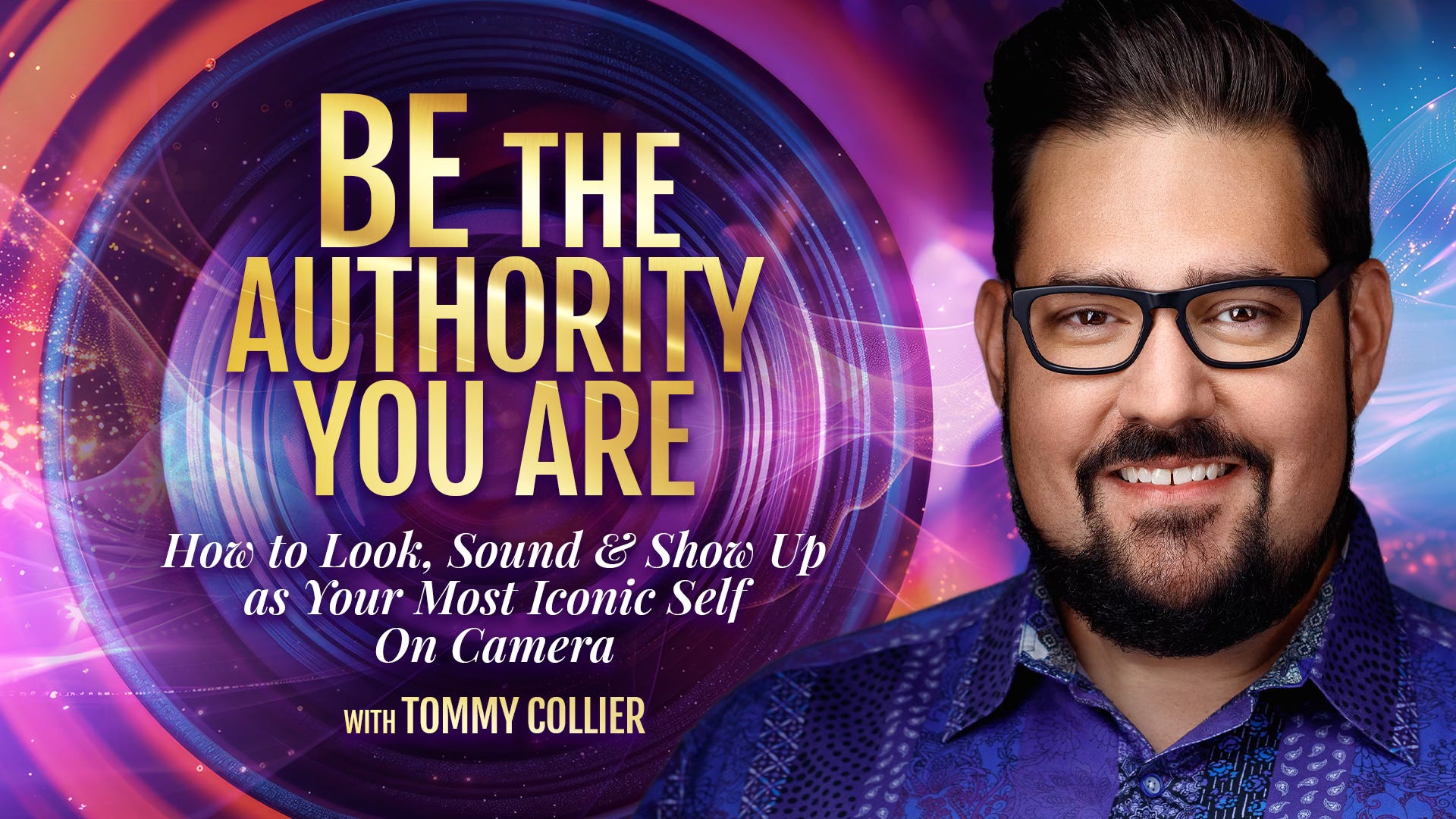
Be The Authority You Are
Free Live Masterclass with Tommy Collier
Thursday, May 14
12 PM Pacific / 3 PM Eastern
You can register here: https://www.thecolliercollective.com/be-the-authority-on-camera-masterclass
Block it on your calendar after you register.
Come live if you can.
And bring a friend whose work is way too good for their camera setup to keep underselling them.
Because most people do not have a content problem.
They have a presence problem.
And when your presence matches your level, everything changes.
Oops! I missed your class. Will there be another?
Love this - we have similar views.